Twenty-odd modules, grouped by the job they do. Nothing here is a roadmap item — every one of these is in the product today, and each entry says plainly what it does and why it works that way.
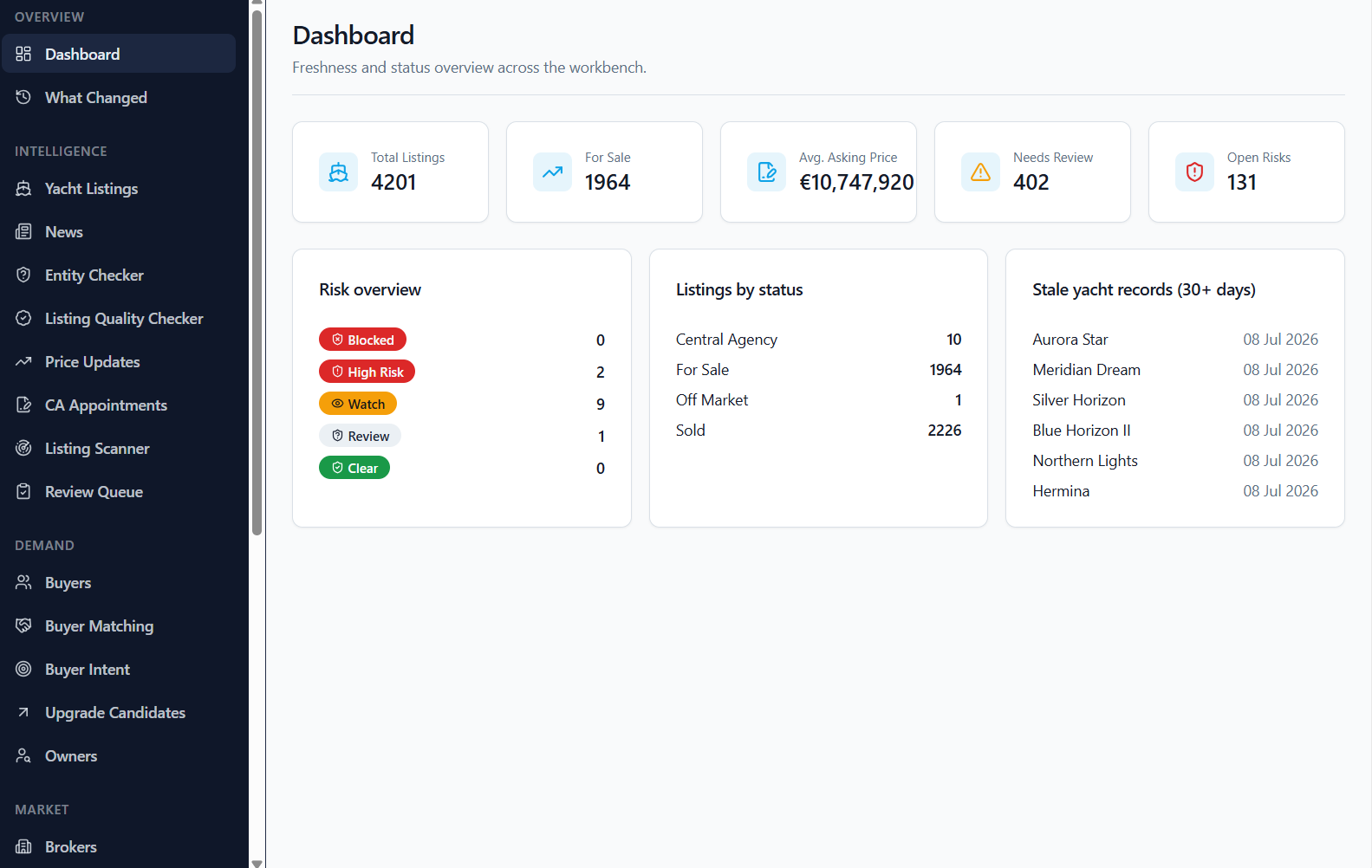
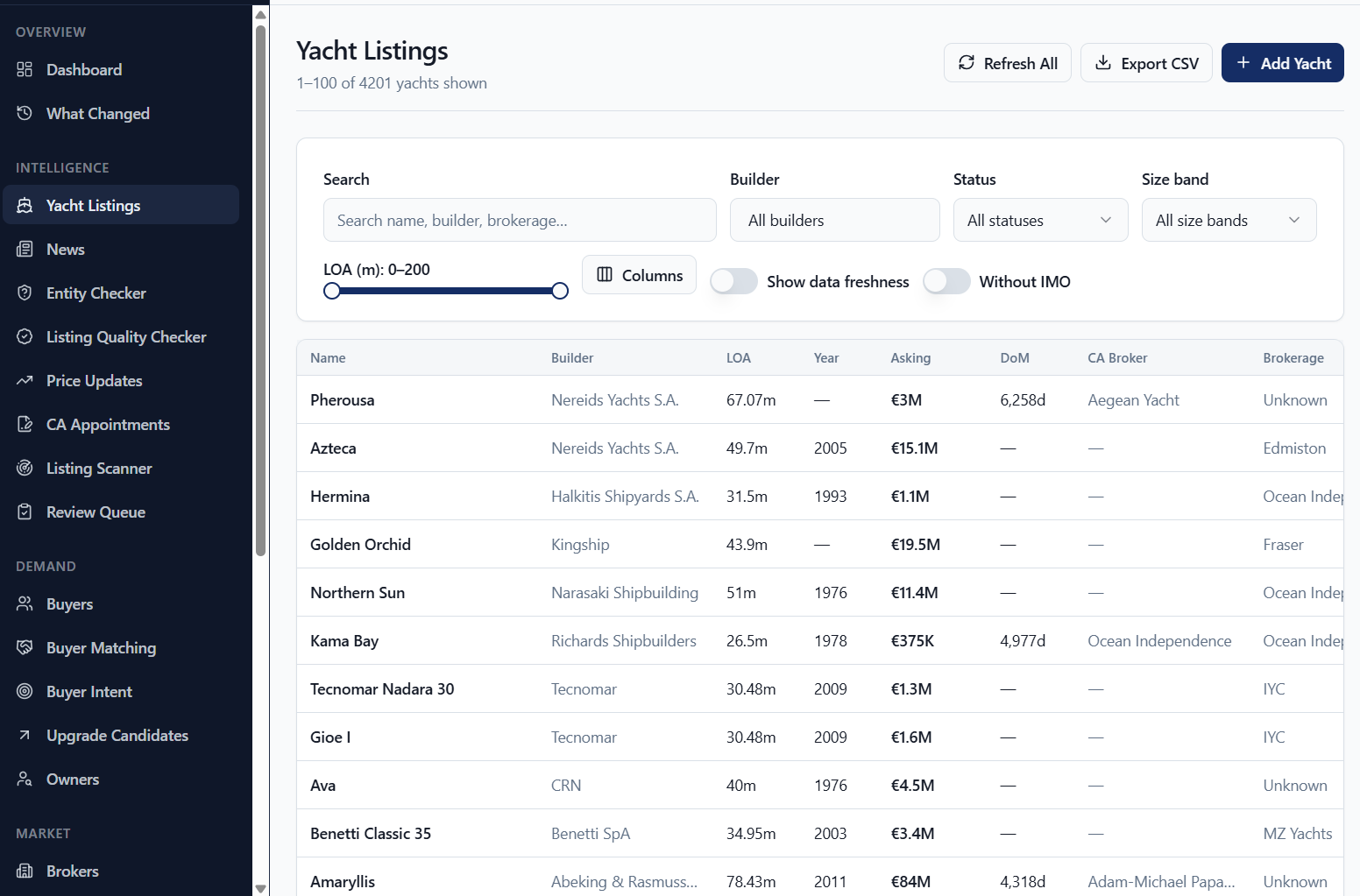
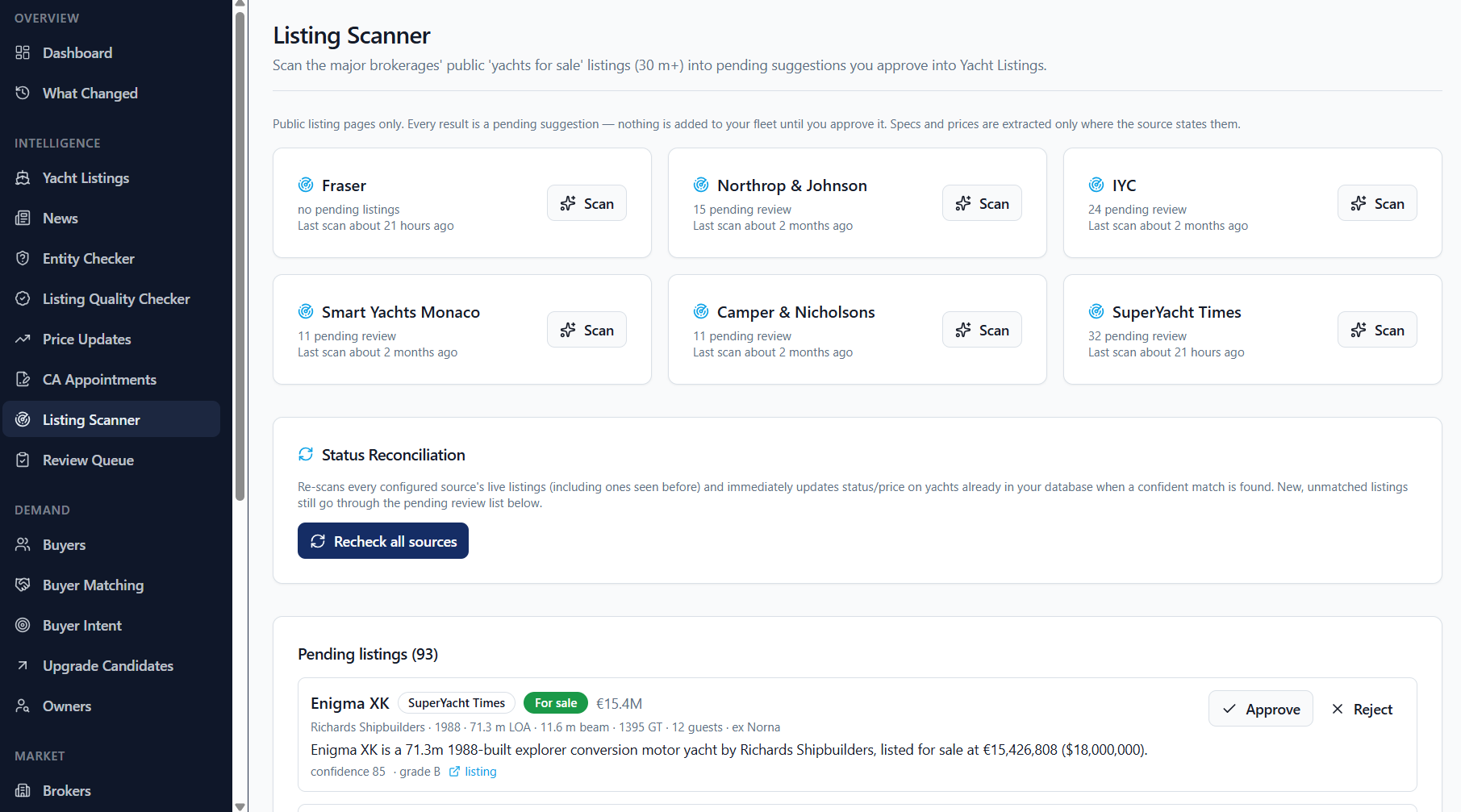
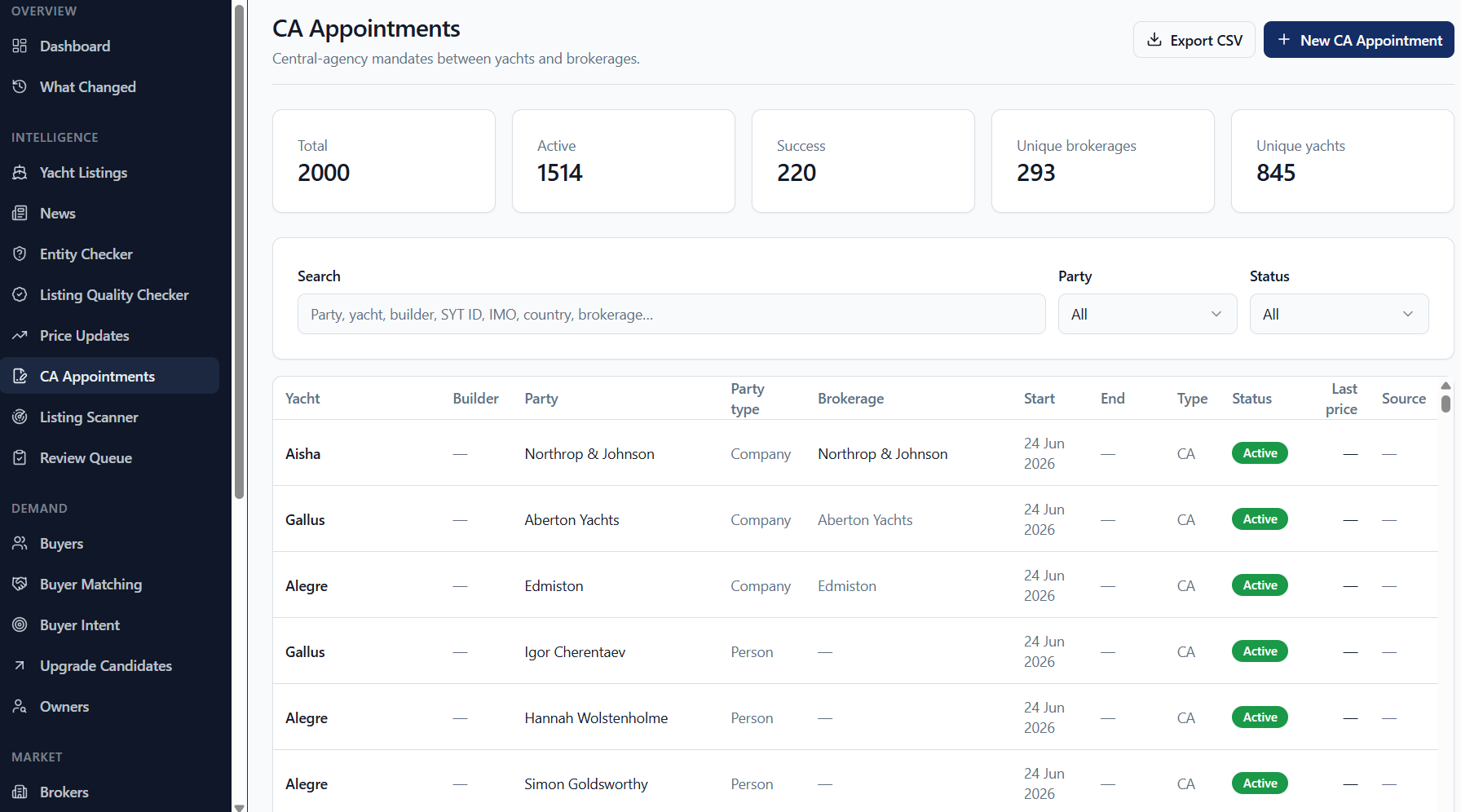
Every screen below is the live product, not a mock-up.
The core record: every tracked yacht, what it is asking, who has the mandate, and how stale that knowledge is. The last part matters most — a price you cannot date is not intelligence.
A maintained profile per yacht — specs, asking price, brokerage, central agent, location and status — filterable across every field and exportable in full.
Every derived number is computed on read from the underlying facts, never stored. It cannot drift away from the evidence it came from.
Scans the public "yachts for sale" pages of Fraser, IYC, Camper & Nicholsons, Northrop & Johnson, SuperYacht Times and Smart Yachts Monaco for anything 30 m and above.
Two yachts can genuinely share a name — this database holds three distinct vessels called Maverick. Matching therefore checks length and build year too, and refuses to merge on a name alone.
Re-reads listings you have seen before to catch what quietly changed: a price cut, a move to under-offer, a withdrawal. One button on the listings page brings the whole fleet up to date.
The full price history of every yacht: what it was, what it became, when, and on whose authority.
One real price change is one event, however many sources report it. A scan, a news article and a manual entry describing the same move are recognised as the same thing — otherwise every metric counting price updates would be inflated by duplicates.
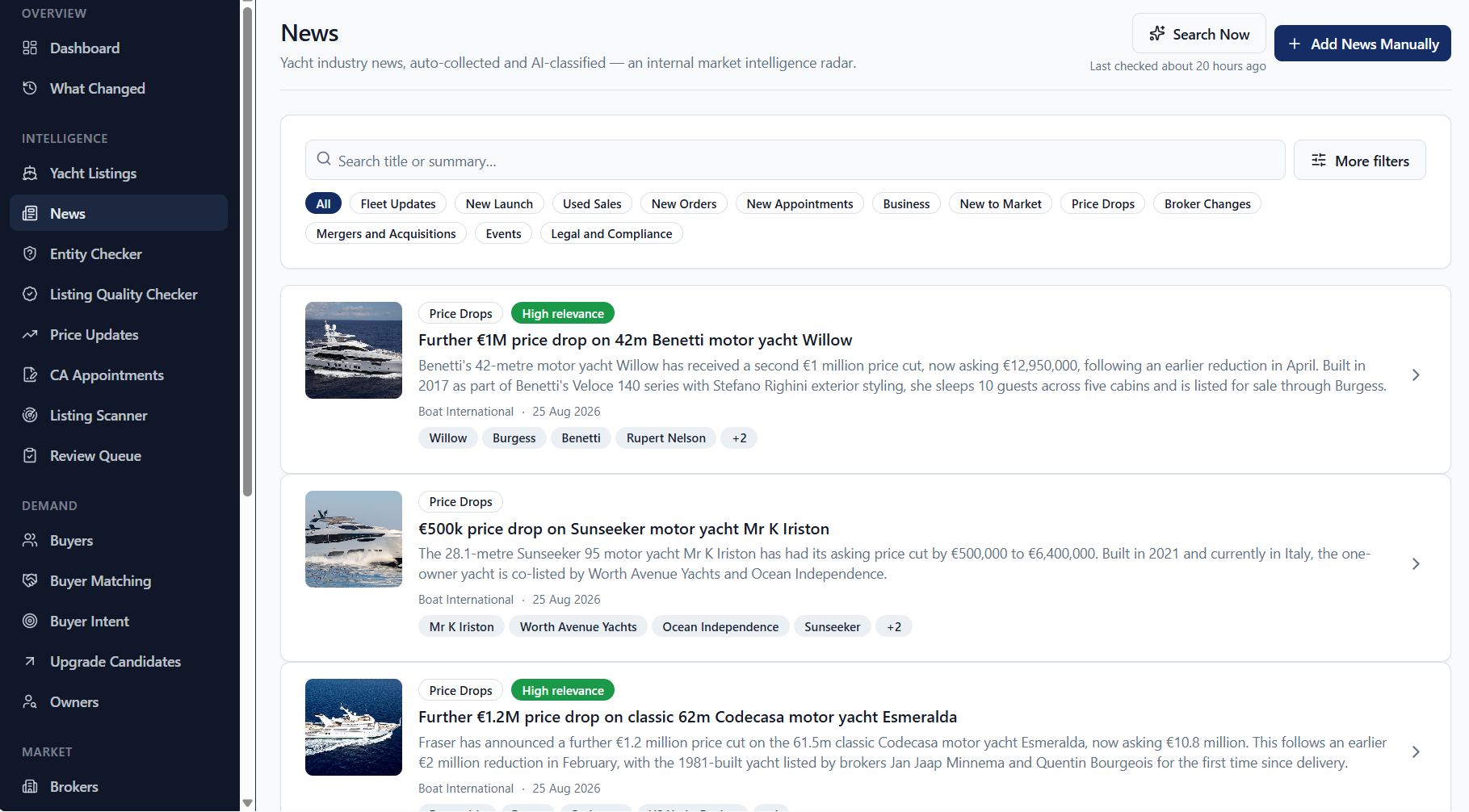
Industry news collected automatically and classified by AI into a dozen categories — new launches, used sales, new orders, appointments, price drops, broker changes, M&A, legal and compliance, and more.
Central-agency mandates between yachts and brokerages, tracked across the fleet — who held which boat, over which period, and how it ended.
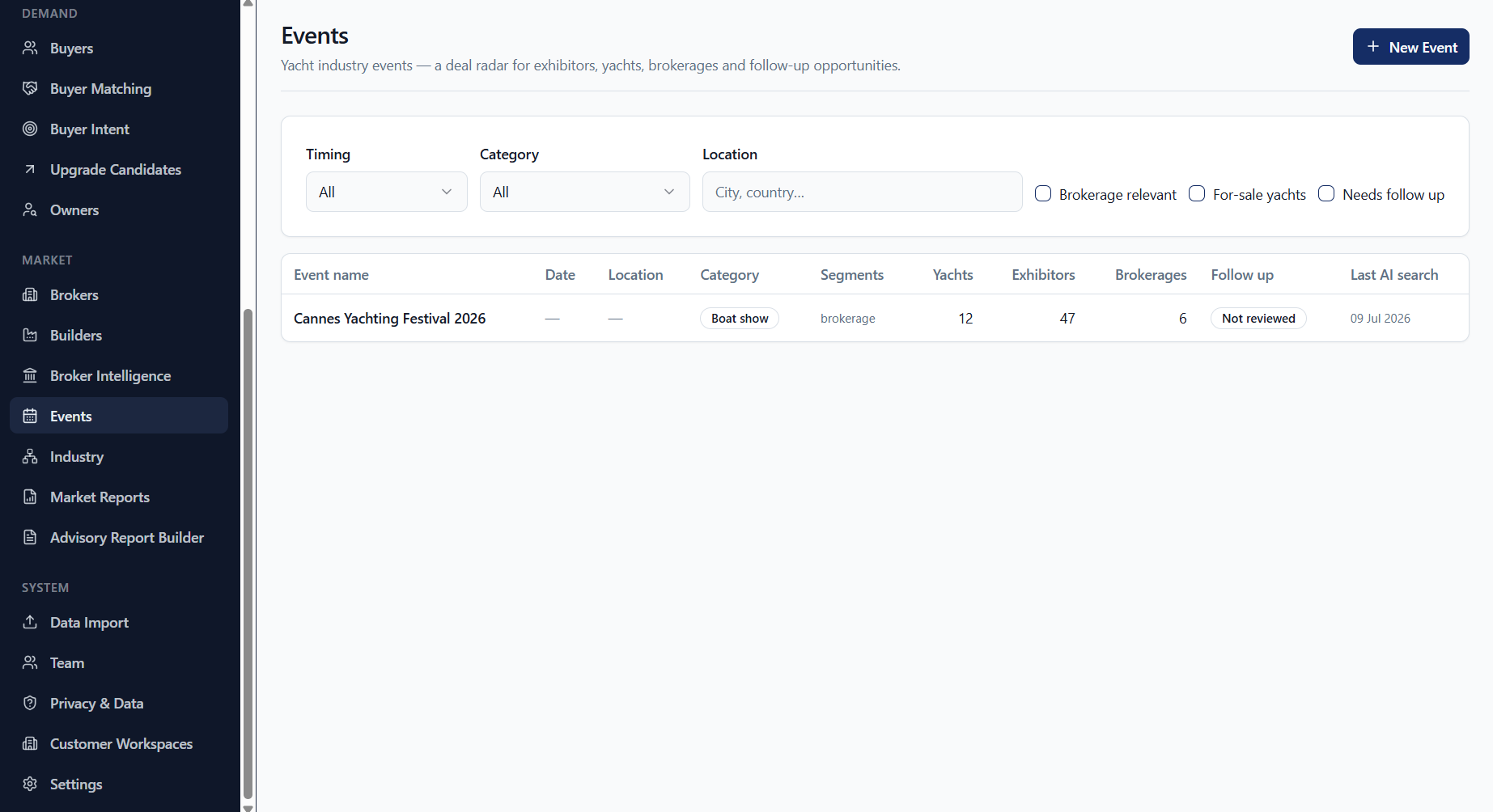
Boat shows and industry events as a deal radar rather than a calendar: who exhibited, which yachts were shown, and what is worth following up.
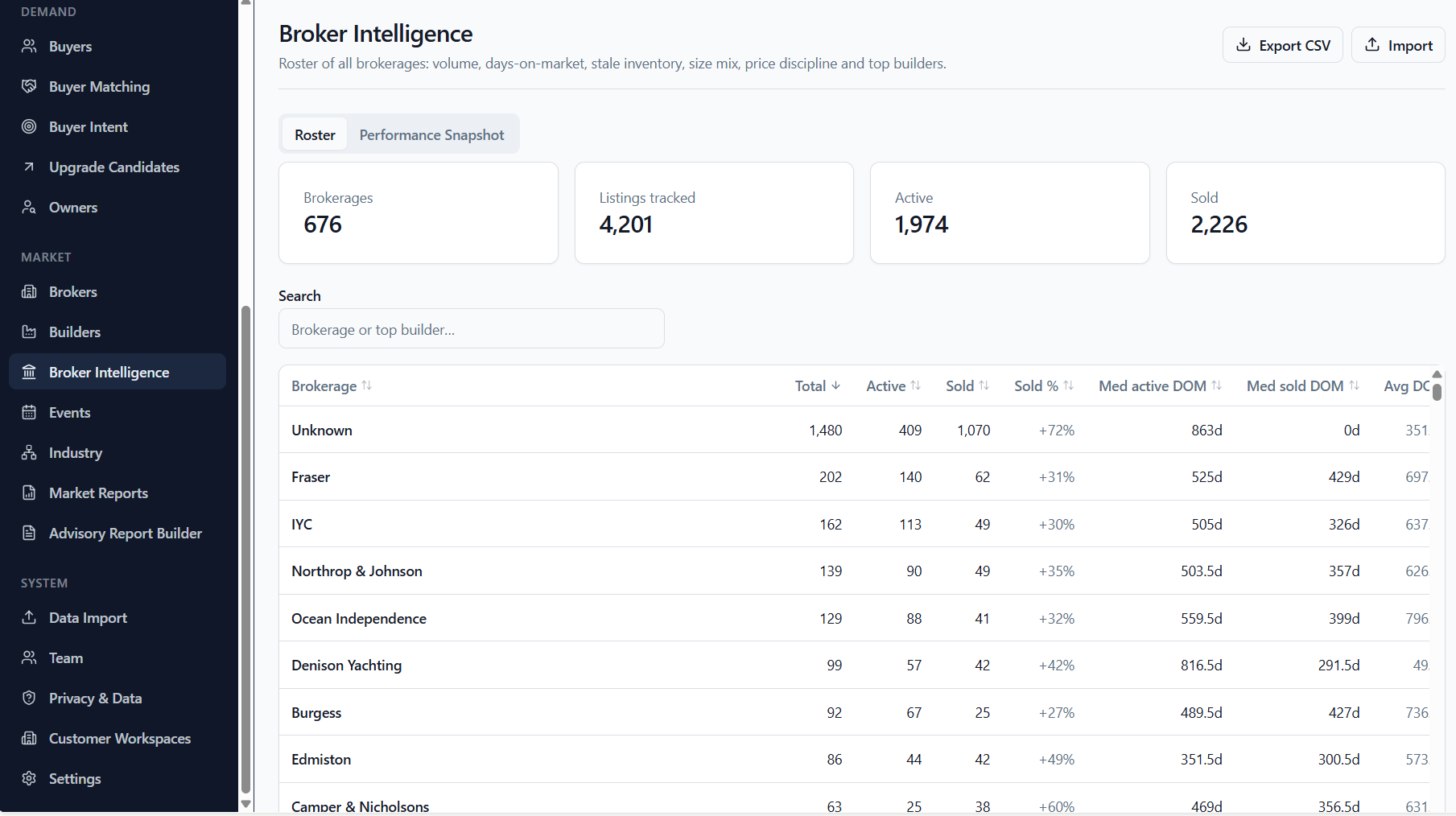
Performance measured against a comparable segment rather than in the abstract — a 40 m Mediterranean specialist should not be judged against a firm selling 90 m explorers.
Filter the whole market by builder, region, type, price band, days-on-market or status, then benchmark one brokerage — or one individual broker — against exactly that segment.
Distributions, not just averages. A handful of multi-year-stale listings drags an average days-on-market into meaninglessness, so the median and percentiles are shown first — and the number of listings behind every figure is always visible.
Every broker and builder active in the tracked market, with their listings, relationships and history attached.
Aggregate analytics across segments, builders and regions, exportable to XLSX or PDF.
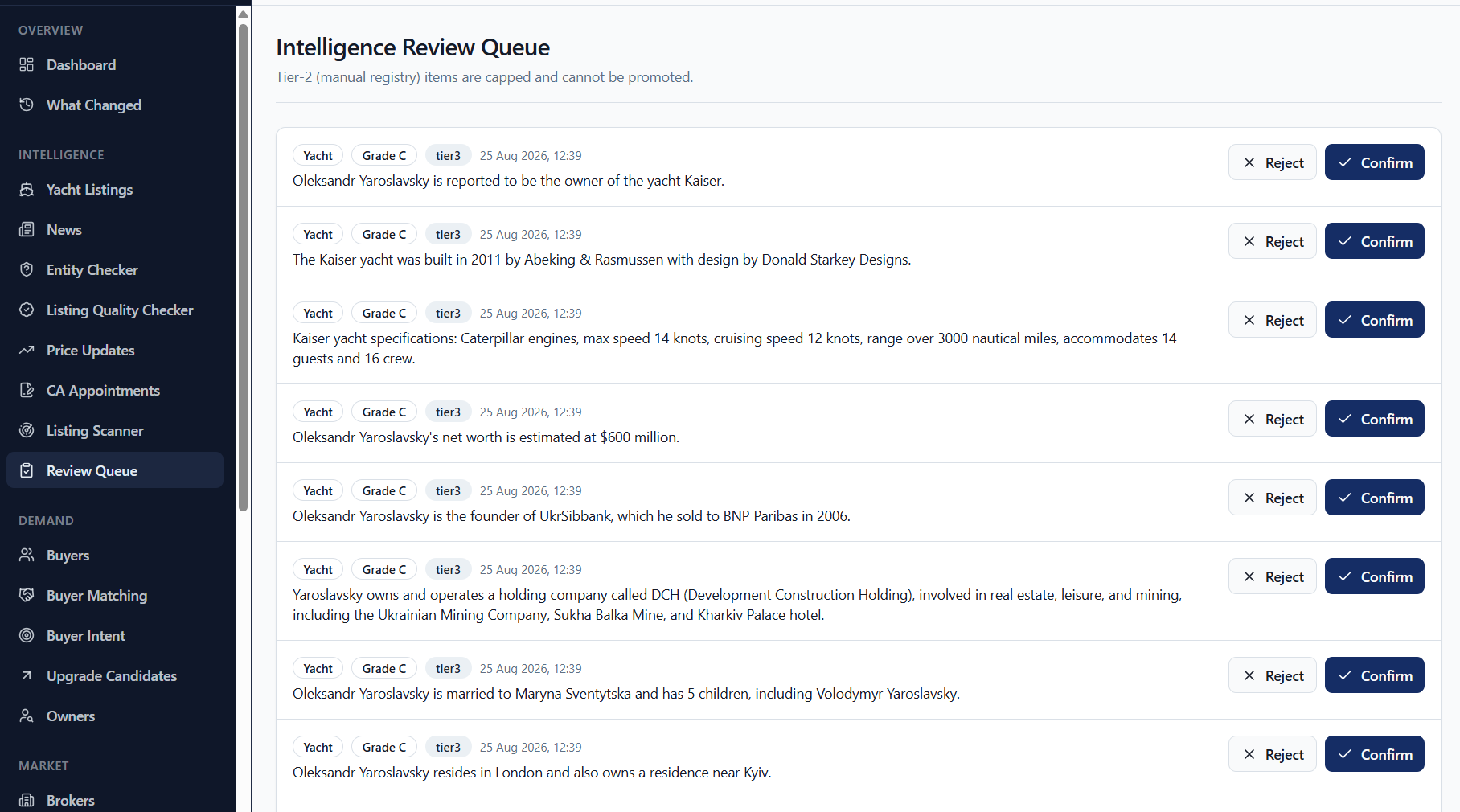
The part of a transaction that goes wrong slowly and then all at once. Everything here is evidence-led: a finding is a claim with a source attached until a person confirms it.
Public-source research into beneficial ownership, run per yacht or per owner, returning claims rather than conclusions.
Four-eyes by construction. The research assistant proposes; a person disposes. That is the difference between intelligence you can put in front of a client and a scraped guess.
Maps the corporate layers between a vessel and the person who ultimately benefits, and scores how opaque that structure is.
Screens any individual or company against sanctions exposure, adverse media and ownership red flags before a deal moves.
Graded flags on yachts and entities, folded into a single overall risk verdict per subject.
Your risk assessments are your firm's own position, not a fact about the market — so they stay private to your workspace even though the yacht they point at is shared.
Prospecting driven by observable signals rather than a feeling about who might be interested.
Scores how likely a person or company is to be in-market, from evidence gathered across news, events and ownership activity.
Evidence confidence is deliberately separate from intent. A high score from one weak source should not read the same as a high score from four independent ones.
Buyer profiles with budget, size, builder and year criteria, scored against live inventory.
Owners whose current vessel, holding period and market position suggest they are due to move up.
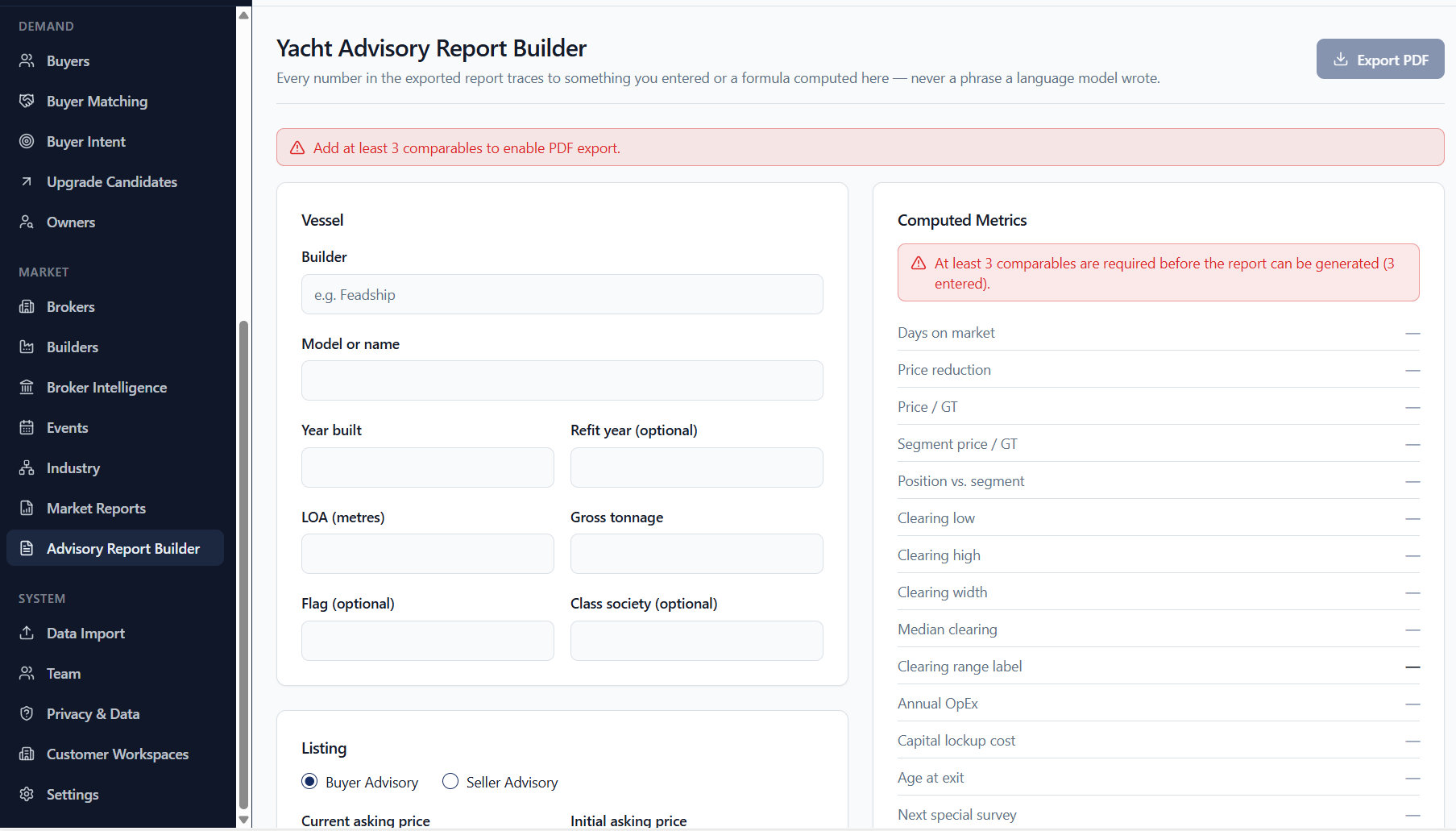
The end of the workflow: a document that holds up when someone asks where a number came from.
A print-ready two-page advisory PDF for a buyer or seller mandate, built from comparables and the subject vessel's own record.
If the comparables are too thin or too scattered to support a range, the report says so and suppresses the figure rather than printing a number that looks authoritative and is not.
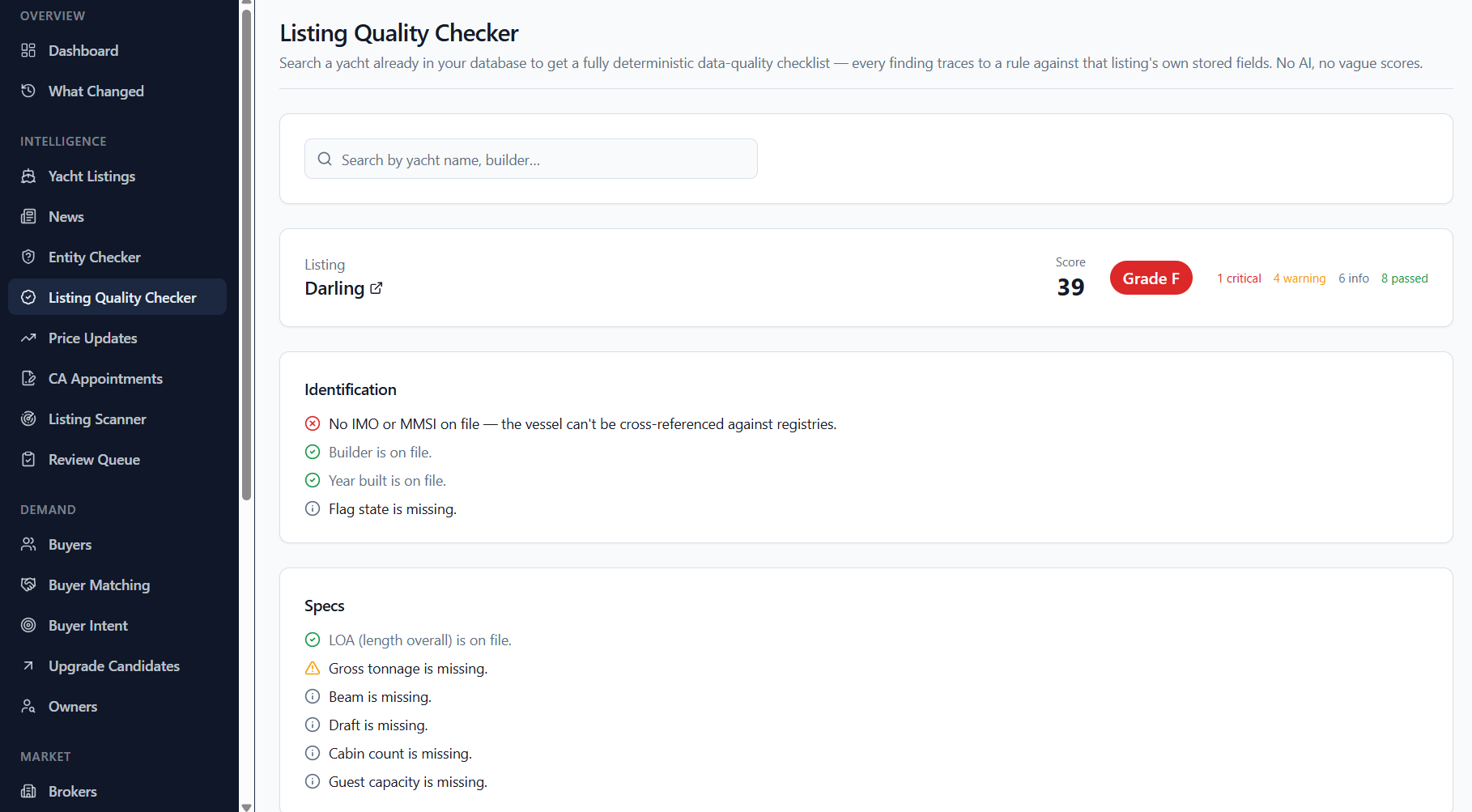
Grades a listing's completeness and internal consistency before it reaches a client-facing document.
Bulk import of yachts, price updates, CA appointments, buyers and owners from CSV or Excel.
The parts you notice only when they are missing.
Collection and reconciliation run on a schedule, and a "What Changed" view answers the question you actually have after a day away.
The fleet is priced in euros, dollars and sterling. Anything that compares or combines those converts first.
Your firm gets its own workspace. Market data is shared across subscribers; your client work is partitioned at the database level.
The platform holds personal data about identifiable people, so it ships with the tools to answer for it.
Deleting someone is not enough on its own. If the next scan rediscovers them from the same public page, nothing was honoured — which is why erasure and suppression are one action here, not two.
Tell us which brokerage you're with and we'll set up your workspace — usually the same day. No card, and nothing to install.
pd@yacht-advisor.com